TROU DU NORD, Haiti — Its capital is blighted with earthquake rubble. Its countryside is shorn of trees, chopped down for fuel. And yet, Haiti's land may hold the key to relieving centuries of poverty, disaster and disease: There is gold hidden in its hills — and silver and copper, too.
A flurry of exploratory drilling in the past year has found precious metals worth potentially $20 billion deep below the tropical ridges in the country's northeastern mountains. Now, a mining company is drilling around the clock to determine how to get those metals out.
In neighboring Dominican Republic, workers are poised to start mining the other side of this seam later this year in one of the world's largest gold deposits: 23 million ounces worth about $40 billion.
The Haitian government's annual budget is $1 billion, more than half provided by foreign assistance. The largest single source of foreign investment, $2 billion, came from Haitians working abroad last year. A windfall of locally produced wealth could pay for roads, schools, clean water and sewage systems for the nation's 10 million people, most of whom live on as little as $1.25 a day.
"If the mining companies are honest and if Haiti has a good government, then here is a way for this country to move forward," said Bureau of Mines Director Dieuseul Anglade.
In a parking lot outside Anglade's marble-floored office, more than 100 families have been living in tents since the earthquake. "The gold in the mountains belongs to the people of Haiti," he said, gesturing out his window. "And they need it."
Haiti's geological vulnerability is also its promise. Massive tectonic plates squeeze the island with horrifying consequences, but deep cracks between them form convenient veins for gold, silver and copper pushed up from the hot innards of the planet. Prospectors from California to Chile know earthquake faults often have, quite literally, a golden lining.
Until now, few Haitians have known about this buried treasure. Mining camps are unmarked, and the work is being done miles up dirt roads near remote villages, on the opposite side of the country from the capital. But U.S. and Canadian investors have spent more than $30 million in recent years on everything from exploratory drilling to camps for workers, new roads, offices and laboratory studies of samples. Actual mining could be under way in five years.
"When I first heard whispers of this I said, 'Gold mines? There could be gold mines in Haiti?'" said Michel Lamarre, a Haitian engineer whose firm, SOMINE, is leading the exploration. "I truly believe this is our answer to taking care of ourselves instead of constantly living on donations."
On a rugged, steep Haitian ridge far above the Atlantic, brilliant boulders coated with blue-green oxidized copper jut from the hills, while colorful pebbles litter the soil, strong indicators that precious metals lie below.
"Just look down," said geologist John Watkins. "Where there's smoke, there's fire."
Nearby, 8-year-old Whiskey Pierre and his barefoot buddies stared at a team of sweat-drenched men driving a narrow, shrieking diamond bit 900 feet into the ground.
"That is a drill!" shouted Whiskey, bouncing on his toes. "The man drill to get gold!"
The workers periodically pulled up samples and knocked them into boxes. The first 40 feet yielded loose rocks and gravel. About 160 feet down, cylinders of rock came back peppered with gold. At 1,000 feet down, rocks were heavily streaked with copper.
Geologists extrapolating from depth and strike reports estimate at least 1 million ounces of gold at two sites. In April, prospectors found the first significant silver ever reported in Haiti: between 20 million and 30 million ounces. And in the end, it may be copper that is the most lucrative: geologists suspect that more than 1 million tons lay in just one of many areas under exploration.
The prices of precious metals have been volatile in recent years, with copper selling for about $8,000 per ton, silver at $30 an ounce, and gold at $1,600 per ounce.
"Ultimately, I think mining is going to dwarf anything else in Haiti," says Michael Fulp, an Albuquerque, N.M.-based geologist who visited the drill sites. "Usually you've got about a one-in-1,000 chance of making a mine from the exploratory stage, but those odds are much better in Haiti because of the lack of any previous modern-day exploration and very, very promising samples."
Gold was last gathered in Haiti in the 1500s, after Christopher Columbus ran the Santa Maria onto a Haitian reef. Spaniards enslaved the Arawak Indians to dig for gold, killing them off with harsh conditions and infectious diseases. When the Spaniards learned of even more lucrative deposits in Mexico, they moved on.
In the 1970s, United Nations geologists documented significant pockets of gold and copper, but foreigners weren't willing to risk their cash in a country where corruption and instability has long discouraged outside investment.
Ironically, it was only after the catastrophic 2010 earthquake that investors saw real opportunity. Fifteen days after a seismic jolt brought down much of Port-au- Prince, a Canadian exploration firm acquired all of the shares of the only Haitian firm holding full permits for a promising chunk of land in the northeast.
"Investors want to get in at the bottom," said Dan Hachey, president of Majescor Resources, the Canadian company, "and I figured after that earthquake, Haiti was as low as it could get."
Hachey was also betting that the $10 billion in foreign assistance promised for earthquake recovery would force change and accountability.
"The eyes of the world will not allow the government to fool around," he said.
Three firms are considering mining in Haiti, but so far only SOMINE has full concessions to take the metals out of the mountains. Those permits, for 31 square miles, were negotiated in 1996 under President Rene Preval and require the firm to hire Haitians whenever possible.
In exchange for minimal permit fees, SOMINE committed to spend $2.25 million in the first two years. In addition, it will pay $1.8 million after a feasibility study, according to the contract.
Bottom line: Haitians should get $1 out of every $2 of profits, compared with about $1 out of $3 that most countries get from mining firms.
Discoveries of rich resources, whether diamonds, oil or gold, often prompt great economic booms but come with great risk of environmental, health and social problems. Chile, one of the wealthiest nations in Latin America, is the world's largest copper exporter, deriving a third of its income from the metal. Peru, with one of the fastest growing economies in the world, has privatized most of its mines in recent years, and now gets about 20 percent of its total revenues from the industry.
Though the contractual terms are generous for Haiti, there is plenty to be cautious about. Haiti's government is repeatedly rated as one of the most corrupt in the world. The mines would ostensibly be regulated by government officials responsible for enforcing environmental, mining and corporate laws, but at this point those officials don't exist and there are neither plans nor budgets to hire them.
Further, open pit mines, common around the world, are crater-like holes made up of a series of massive terraced steps that drop thousands of feet into the ground. When the resources are exhausted, usually after about 25 years, the pits can be refilled or converted into reservoirs. In many cases, the mines leave serious problems — environmental contamination, displaced communities and mountaintops torn asunder.
From Papua New Guinea to the Philippines to Brazil, mining accidents have allowed tons of waste to be spilled into rivers and lakes, creating environmental disasters.
"In low-income countries, the dangers are substantial," said UCLA political science professor Michael Ross. "The great irony of mineral wealth is that those countries that most desperately need infusions of mineral revenue — low-income countries with weak governments — are also least likely to manage these resources wisely, for the benefit of the country.
Already, the hundreds of jobs, the new roads and the community investment in a country where two out of three people have no formal employment is much appreciated.
Stone cutter Joseph Bernard, 47, says that before he got a job slicing rock samples, his family was going hungry. They had one cow. Their peanut and bean fields had gone to dust after months without rain.
Today, his wife has launched a business selling seeds, and his son and two daughters have started school.
"I found a job, but many didn't," he said, wiping a trickle of sweat from his deeply lined cheeks after a recent shift. "If more companies come, more people will work."
In a sleepy exploration camp at sunset, Hachey and his competitor, Daven Mashburn of Newmont Mining Corp., met to talk business over bottles of Haiti's Prestige beer, bumping fists in the low-germ "cholera handshake" that has replaced the traditional palm grip after last year's deadly epidemic.
The men talked labor — Newmont got 10,000 applications for 100 jobs when one project started up last month. They talked logistics — core samples are sliced in half, bagged, and flown to Santiago, Chile, where it takes 21 days to find out how much gold, silver or copper they contain. They talked hurricanes, cholera, political unrest and, yes, the earthquake — Mashburn spent four hours buried under piles of rock in Port-au- Prince, eventually pulled out with fractures from head to toe.
But mostly they talked about gold.
"Of all the places we work in the world," said Mashburn, whose company has operations in eight countries on five continents, "it would be really most satisfying to have success here. Haiti has great mineral wealth, and they surely could use it."
(SOURCE: http://today.msnbc.msn.com/id/47398045/ns/world_news-americas/)
Sunday, May 13, 2012

Thursday, April 5, 2012
Desert Planet O1
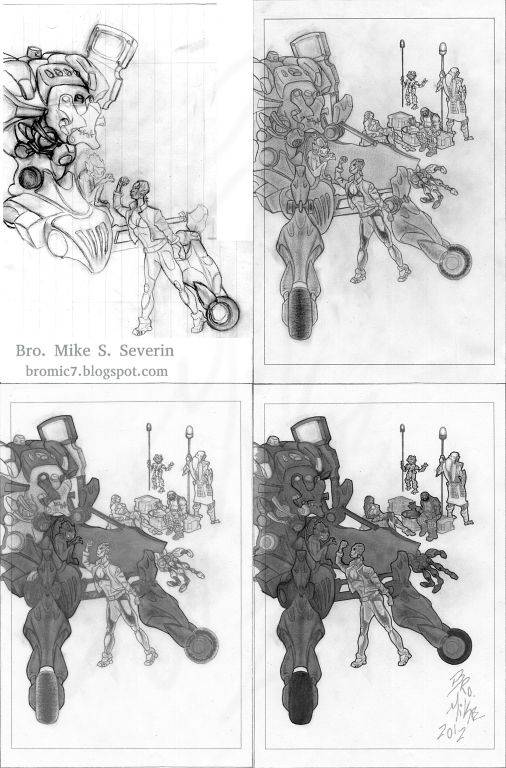

Early pencil sketches & digital paint for the 'CORSAIRS' Draw-Off Art Contest 2012. Still got some work to do on this illustration ... will post the final pic when it's complete.
Thursday, January 12, 2012
Haiti 2 Years Later
On this day two years ago, a 7.0 earthquake devastated Haiti. An estimated 316,000 people had died, 300,000 had been injured and 1 million became homeless.
Two years later Haiti still faces many, many challenges. More than 500,000 people remain on the street. Families continue to live in plastic tents. Over 200 people are dying of cholera per month. Some say in much of Haiti, it appears as though the earthquake hit two months ago, not two years ago.
It has been reported that half the money world governments pledged to Haiti never showed up. Half the money American private donors raised for Haiti hasn't been spent. And many millions went to things other than direct aid. Some experts say it will take another 10 years of spending before people see serious results ... WHAT?
Kreyòl:
Sou jou sa a de zan de sa, yon tranbleman 7.0 tè devaste Ayiti. Yon valè estime 316,000 moun ki te mouri, te gen 300,000 te andomaje epi 1,000,000 te vin sanzabri.
De ane pita Ayiti toujou ap fè fas anpil, defi anpil. Plis pase 500,000 moun yo rete sou lari a. Fanmi yo kontinye ap viv nan kan anba tant twal plastik. Plis pase 200 moun ap mouri nan kolera chak mwa. Gen moun ki di nan anpil nan Ayiti, li parèt tankou si tranbleman tè a frape de mwa de sa, se pa de zan de sa.
Li te gen te rapòte ke mwatye gouvènman yo mond lajan plede an Ayiti pa janm parèt vin. Mwatye lajan Ameriken donatè prive yo leve soti vivan pou Ayiti pa te depanse. Ak anpil milyon te ale nan lòt bagay pase èd dirèk. Gen kèk ekspè yo di li pral pran yon lòt 10 zan nan depans devan tout foul moun wè rezilta grav ... KI SA?
Française:
En ce jour il ya deux ans, un séisme de 7.0 a dévasté Haïti. Une estimation 316,000 personnes avaient été tuées, 300,000 avaient été blessés et 1,000,000 devenu sans-abri.
Deux ans plus tard Haïti est confronté à encore beaucoup, beaucoup de défis. Plus de 500,000 personnes restent dans la rue. Les familles continuent de vivre dans des tentes en plastique. Plus de 200 personnes meurent du choléra par mois. Certains disent que dans une grande partie d'Haïti, il semble que le tremblement de terre a frappé il ya deux mois, et non pas il ya deux ans.
Il a été rapporté que la moitié des gouvernements du monde de l'argent promis à Haïti ne s'est jamais présenté. La moitié de la monnaie américaine donateurs privés levés pour Haïti n'a pas été dépensé. Et plusieurs millions allé à d'autres choses que des aides directes. Certains experts disent qu'il faudra encore 10 ans avant de passer les gens voient des résultats sérieux ... QU'EST-CE?
Two years later Haiti still faces many, many challenges. More than 500,000 people remain on the street. Families continue to live in plastic tents. Over 200 people are dying of cholera per month. Some say in much of Haiti, it appears as though the earthquake hit two months ago, not two years ago.
It has been reported that half the money world governments pledged to Haiti never showed up. Half the money American private donors raised for Haiti hasn't been spent. And many millions went to things other than direct aid. Some experts say it will take another 10 years of spending before people see serious results ... WHAT?
Kreyòl:
Sou jou sa a de zan de sa, yon tranbleman 7.0 tè devaste Ayiti. Yon valè estime 316,000 moun ki te mouri, te gen 300,000 te andomaje epi 1,000,000 te vin sanzabri.
De ane pita Ayiti toujou ap fè fas anpil, defi anpil. Plis pase 500,000 moun yo rete sou lari a. Fanmi yo kontinye ap viv nan kan anba tant twal plastik. Plis pase 200 moun ap mouri nan kolera chak mwa. Gen moun ki di nan anpil nan Ayiti, li parèt tankou si tranbleman tè a frape de mwa de sa, se pa de zan de sa.
Li te gen te rapòte ke mwatye gouvènman yo mond lajan plede an Ayiti pa janm parèt vin. Mwatye lajan Ameriken donatè prive yo leve soti vivan pou Ayiti pa te depanse. Ak anpil milyon te ale nan lòt bagay pase èd dirèk. Gen kèk ekspè yo di li pral pran yon lòt 10 zan nan depans devan tout foul moun wè rezilta grav ... KI SA?
Française:
En ce jour il ya deux ans, un séisme de 7.0 a dévasté Haïti. Une estimation 316,000 personnes avaient été tuées, 300,000 avaient été blessés et 1,000,000 devenu sans-abri.
Deux ans plus tard Haïti est confronté à encore beaucoup, beaucoup de défis. Plus de 500,000 personnes restent dans la rue. Les familles continuent de vivre dans des tentes en plastique. Plus de 200 personnes meurent du choléra par mois. Certains disent que dans une grande partie d'Haïti, il semble que le tremblement de terre a frappé il ya deux mois, et non pas il ya deux ans.
Il a été rapporté que la moitié des gouvernements du monde de l'argent promis à Haïti ne s'est jamais présenté. La moitié de la monnaie américaine donateurs privés levés pour Haïti n'a pas été dépensé. Et plusieurs millions allé à d'autres choses que des aides directes. Certains experts disent qu'il faudra encore 10 ans avant de passer les gens voient des résultats sérieux ... QU'EST-CE?
Wednesday, April 6, 2011
Haiti Election - Preliminary Results
On April 4, 2011 a senior Haitian official announced that Michel 'Sweet Micky' Martelly won the run-off Haitian Presidential Election against candidate Mirlande Manigat. However, official results are not expected until April 16.
Kreyòl:
Sou 4 Avril 2011 yon wo ofisyèl Ayisyen anonse ke Michel 'Sweet Micky' Martelly te ranpòte dezyèm tou Eleksyon Prezidansyèl Ayisyen kont kandida Mirlande Manigat. Men, rezilta ofisyèl yo pa atann jouk 16 Avril.
Française:
Le 4 Avril 2011 un haut officiel Haïtien a annoncé que Michel 'Sweet Micky' Martelly a remporté le deuxième tour des Élections Présidentielles Haïtiennes contre le candidat Mirlande Manigat. Cependant, les résultats officiels ne sont pas attendus avant le 16 Avril.
Kreyòl:
Sou 4 Avril 2011 yon wo ofisyèl Ayisyen anonse ke Michel 'Sweet Micky' Martelly te ranpòte dezyèm tou Eleksyon Prezidansyèl Ayisyen kont kandida Mirlande Manigat. Men, rezilta ofisyèl yo pa atann jouk 16 Avril.
Française:
Le 4 Avril 2011 un haut officiel Haïtien a annoncé que Michel 'Sweet Micky' Martelly a remporté le deuxième tour des Élections Présidentielles Haïtiennes contre le candidat Mirlande Manigat. Cependant, les résultats officiels ne sont pas attendus avant le 16 Avril.
Friday, March 18, 2011
Aristide returns to Haiti, days before election
(latimes.com)
Port-au-Prince, Haiti— In the face of international pressure to keep him out, former Haitian President Jean-Bertrand Aristide returned home Friday after seven years in exile, tossing a combustible new ingredient into the presidential election that is scheduled to take place Sunday.
Aristide arrived on a charter flight from South Africa, where he has lived for most of the time since he was flown out of Haiti on a U.S.-supplied plane amid turmoil in 2004.
He was greeted at a VIP arrival area at the airport in Port-au-Prince, Haiti's capital, by some supporters and 100 or so airport workers, some waving little Haitian flags.
Aristide, in a dark suit, waved and clasped his hands as he stepped down to the tarmac, and was then swarmed by dozens of journalists.
Aristide, a leftist former priest, remains a deeply polarizing figure in Haiti, where he is revered by many poor residents as a defender of the downtrodden but detested by wealthy elites and others who see him as a volatile force in the country's politics.
Speculation over Aristide's return had gripped the country since the Haitian government issued him a passport in February, just weeks after former Haitian dictator Jean-Claude Duvalier made a surprise return.
But it became clear only in recent days that Aristide would return, as his supporters and lawyer began to promise that he would be back on Haitian soil before Sunday, when voters go the polls to choose a new president and parliament.
At the house on the edge of Port-au-Prince where Aristide once lived, workers repainted a tall surrounding wall in faint rose pink and planted scores of tiny Haitian flags along the top.
U.S. officials, including President Obama, had sought to keep Aristide from making the trip home, arguing that his arrival could prove a destabilizing factor during the closing phase of the presidential runoff between Michel Martelly, a popular singer, and Mirlande Manigat, a university vice rector who was once Haiti's first lady.
But South African officials said they had no power to prevent the former Haitian leader from going anywhere he chose.
Aristide left Johannesburg late Thursday, accompanied by his wife, two daughters, actor Danny Glover and the former leader's Miami-based lawyer.
Aristide has said he wanted to return to work in the education field, not politics. He has also said chronic eye problems are aggravated by South Africa's cold weather.
But Aristide's profile and the fractured condition of Haiti left may make it difficult for him to stay out of political life entirely.
Port-au-Prince, Haiti— In the face of international pressure to keep him out, former Haitian President Jean-Bertrand Aristide returned home Friday after seven years in exile, tossing a combustible new ingredient into the presidential election that is scheduled to take place Sunday.
Aristide arrived on a charter flight from South Africa, where he has lived for most of the time since he was flown out of Haiti on a U.S.-supplied plane amid turmoil in 2004.
He was greeted at a VIP arrival area at the airport in Port-au-Prince, Haiti's capital, by some supporters and 100 or so airport workers, some waving little Haitian flags.
Aristide, in a dark suit, waved and clasped his hands as he stepped down to the tarmac, and was then swarmed by dozens of journalists.
Aristide, a leftist former priest, remains a deeply polarizing figure in Haiti, where he is revered by many poor residents as a defender of the downtrodden but detested by wealthy elites and others who see him as a volatile force in the country's politics.
Speculation over Aristide's return had gripped the country since the Haitian government issued him a passport in February, just weeks after former Haitian dictator Jean-Claude Duvalier made a surprise return.
But it became clear only in recent days that Aristide would return, as his supporters and lawyer began to promise that he would be back on Haitian soil before Sunday, when voters go the polls to choose a new president and parliament.
At the house on the edge of Port-au-Prince where Aristide once lived, workers repainted a tall surrounding wall in faint rose pink and planted scores of tiny Haitian flags along the top.
U.S. officials, including President Obama, had sought to keep Aristide from making the trip home, arguing that his arrival could prove a destabilizing factor during the closing phase of the presidential runoff between Michel Martelly, a popular singer, and Mirlande Manigat, a university vice rector who was once Haiti's first lady.
But South African officials said they had no power to prevent the former Haitian leader from going anywhere he chose.
Aristide left Johannesburg late Thursday, accompanied by his wife, two daughters, actor Danny Glover and the former leader's Miami-based lawyer.
Aristide has said he wanted to return to work in the education field, not politics. He has also said chronic eye problems are aggravated by South Africa's cold weather.
But Aristide's profile and the fractured condition of Haiti left may make it difficult for him to stay out of political life entirely.
Wednesday, March 9, 2011
Haiti Election - March 20, 2011
Haiti to combat vote fraud
(upi.com)
PORT-AU-PRINCE, Haiti -- Haitian election officials say providing help for voters and better-educated poll workers will ensure fairness in the upcoming presidential runoff election.
Presidential candidates Mirlande Manigat and Michel "Sweet Micky" Martelly, the top vote-getters in the preliminary round, will square off March 20, along with the two top candidates in legislative districts where no one got 50 percent of the vote, The Miami Herald reported.
The Provisional Electoral Council has set up a call center that provides 24-hour assistance for voters. In addition, all poll workers will be required to have a high school education and workers at the polling stations where fraud was most noticeable have been dismissed.
Gaillot Dorsinville, the council's president, told candidates the body is "prepared to make all of the corrections necessary to better the second round.''
The Organization of American States has also increased its delegation of observers from 120 to 200 for the runoff.
Haitian observers are dubious about the changes. Pierre Esperance heads a group that reported massive fraud in the preliminary voting.
"I have no confidence in the electoral machine," he said.
---------
UN plans to reinforce police for presidential run-off elections
(un.org)
The 3,500-strong United Nations police force in Haiti is planning to reinforce its support of national police for the presidential run-off election on 20 March, although it does not expect trouble, according to the head of the contingent.
“I don’t see any major risk for this second round,” Marc Tardif, head of the police component in the UN Stabilization Mission in Haiti (MINUSTAH), told the UN News Centre in an interview.
“Clearly it’s going to be a tense period but I don’t think we will have big trouble. We have a good working relationship with the national police and our robust presence will deter anybody wanting to create problems,” he said, noting that in the first round in November the two forces worked together, and despite some incidents, the poll took place in much greater calm than previous elections.
“Still, we’re going to reinforce our positions at those places that were unstable during the first round,” he added.
Trouble broke out after the announcement of provisional results in December from the first round, with thousands of protesters rampaging through the streets of Port-au-Prince, the capital, accusing the ruling coalition of rigging the polls, after tallies put former first lady Mirlande Manigat and outgoing President Rene Préval’s party candidate Jude Celestin in first and second place, thus qualifying for the run-off.
Popular musician Michel Martelly was less than one percentage point behind in third place, but thus excluded from the run-off, and his supporters set up burning barricades of timber, boulders and flaming tires.
After a re-examination of the ballots, the Provisional Electoral Council last month announced that Mr. Martelly had come in second and would thus face Ms. Manigat in the run-off.
Apart from its police component, MINUSTAH, which has been on the ground in Haiti since mid-2004 after then president Jean-Bertrand Aristide went into exile amid violent unrest, fields some 8,500 peacekeeping troops in the impoverished country.
---------
Haitian candidate wary of Aristide's planned return
(reuters.com)
MIAMI - A candidate in Haiti's decisive presidential run-off said on Thursday she hoped popular former President Jean-Bertrand Aristide would delay his planned return to the country until after the election later this month.
"Personally, as a citizen, I would prefer that he comes back after the elections," former first lady Mirlande Manigat said in a news conference at Miami's International Airport.
"We are waiting for elections and the situation has been particularly agitated," she added.
Manigat, 70, faces musician Michel "Sweet Mickey" Martelly in the March 20 run-off. She emerged as a front-runner in the November 28 election in the volatile, earthquake-ravaged Caribbean country. The poll was widely criticized as chaotic and fraudulent.
The election also drew controversy over the fact that Aristide's Fanmi Lavalas political party was barred from running a candidate in the poll.
The run-off comes against the backdrop of Aristide's recent announcement that he is planning to return home, ending his prolonged exile in South Africa. He has kept everyone guessing about the timing.
"I think what we need now is more peace," Manigat said, The return of Aristide, a fire-brand left-wing populist, only threatened more "agitation" ahead of the election, she said.
Manigat did not elaborate on her comments suggesting possible unrest. But Aristide, a charismatic former Catholic priest, is loved by many of Haiti's poor and loathed by business leaders and the wealthy elite.
He became Haiti's first freely elected president in 1991 but spent much of his first five-year term in exile after a military coup. Elected again in 2000, his second term was soured by economic instability and gang and drug-related violence. He was finally ousted in a 2004 rebellion led by former soldiers. Aristide says Washington orchestrated it.
Haiti's outgoing government, under intense international pressure to keep shaky U.N.-backed elections on track, has said it cannot keep a citizen from returning and has issued a diplomatic passport for Aristide.
But the possibility that he could return before the March run-off has led the United States, the United Nations and other major western donors to signal they would view such a move as, at best, unhelpful, and at worst, potentially dangerous.
(upi.com)
PORT-AU-PRINCE, Haiti -- Haitian election officials say providing help for voters and better-educated poll workers will ensure fairness in the upcoming presidential runoff election.
Presidential candidates Mirlande Manigat and Michel "Sweet Micky" Martelly, the top vote-getters in the preliminary round, will square off March 20, along with the two top candidates in legislative districts where no one got 50 percent of the vote, The Miami Herald reported.
The Provisional Electoral Council has set up a call center that provides 24-hour assistance for voters. In addition, all poll workers will be required to have a high school education and workers at the polling stations where fraud was most noticeable have been dismissed.
Gaillot Dorsinville, the council's president, told candidates the body is "prepared to make all of the corrections necessary to better the second round.''
The Organization of American States has also increased its delegation of observers from 120 to 200 for the runoff.
Haitian observers are dubious about the changes. Pierre Esperance heads a group that reported massive fraud in the preliminary voting.
"I have no confidence in the electoral machine," he said.
---------
UN plans to reinforce police for presidential run-off elections
(un.org)
The 3,500-strong United Nations police force in Haiti is planning to reinforce its support of national police for the presidential run-off election on 20 March, although it does not expect trouble, according to the head of the contingent.
“I don’t see any major risk for this second round,” Marc Tardif, head of the police component in the UN Stabilization Mission in Haiti (MINUSTAH), told the UN News Centre in an interview.
“Clearly it’s going to be a tense period but I don’t think we will have big trouble. We have a good working relationship with the national police and our robust presence will deter anybody wanting to create problems,” he said, noting that in the first round in November the two forces worked together, and despite some incidents, the poll took place in much greater calm than previous elections.
“Still, we’re going to reinforce our positions at those places that were unstable during the first round,” he added.
Trouble broke out after the announcement of provisional results in December from the first round, with thousands of protesters rampaging through the streets of Port-au-Prince, the capital, accusing the ruling coalition of rigging the polls, after tallies put former first lady Mirlande Manigat and outgoing President Rene Préval’s party candidate Jude Celestin in first and second place, thus qualifying for the run-off.
Popular musician Michel Martelly was less than one percentage point behind in third place, but thus excluded from the run-off, and his supporters set up burning barricades of timber, boulders and flaming tires.
After a re-examination of the ballots, the Provisional Electoral Council last month announced that Mr. Martelly had come in second and would thus face Ms. Manigat in the run-off.
Apart from its police component, MINUSTAH, which has been on the ground in Haiti since mid-2004 after then president Jean-Bertrand Aristide went into exile amid violent unrest, fields some 8,500 peacekeeping troops in the impoverished country.
---------
Haitian candidate wary of Aristide's planned return
(reuters.com)
MIAMI - A candidate in Haiti's decisive presidential run-off said on Thursday she hoped popular former President Jean-Bertrand Aristide would delay his planned return to the country until after the election later this month.
"Personally, as a citizen, I would prefer that he comes back after the elections," former first lady Mirlande Manigat said in a news conference at Miami's International Airport.
"We are waiting for elections and the situation has been particularly agitated," she added.
Manigat, 70, faces musician Michel "Sweet Mickey" Martelly in the March 20 run-off. She emerged as a front-runner in the November 28 election in the volatile, earthquake-ravaged Caribbean country. The poll was widely criticized as chaotic and fraudulent.
The election also drew controversy over the fact that Aristide's Fanmi Lavalas political party was barred from running a candidate in the poll.
The run-off comes against the backdrop of Aristide's recent announcement that he is planning to return home, ending his prolonged exile in South Africa. He has kept everyone guessing about the timing.
"I think what we need now is more peace," Manigat said, The return of Aristide, a fire-brand left-wing populist, only threatened more "agitation" ahead of the election, she said.
Manigat did not elaborate on her comments suggesting possible unrest. But Aristide, a charismatic former Catholic priest, is loved by many of Haiti's poor and loathed by business leaders and the wealthy elite.
He became Haiti's first freely elected president in 1991 but spent much of his first five-year term in exile after a military coup. Elected again in 2000, his second term was soured by economic instability and gang and drug-related violence. He was finally ousted in a 2004 rebellion led by former soldiers. Aristide says Washington orchestrated it.
Haiti's outgoing government, under intense international pressure to keep shaky U.N.-backed elections on track, has said it cannot keep a citizen from returning and has issued a diplomatic passport for Aristide.
But the possibility that he could return before the March run-off has led the United States, the United Nations and other major western donors to signal they would view such a move as, at best, unhelpful, and at worst, potentially dangerous.
Monday, February 7, 2011
Not too late to prosecute Baby Doc: UN
(CARIBBEAT - Jared McCallister)
As expected, Jean-Claude (Baby Doc) Duvalier's return to Haiti after a nearly 25-year exile continues to make news. Last week, the United Nations announced it's not too late to prosecute Duvalier - and it will help.
"Under international law, there is no statute of limitations for serious human rights violations such as torture, extrajudicial killings, enforced disappearances and rape," said Navi Pillay, UN high commissioner for human rights.
Agency officials offered Haiti assistance in prosecuting Duvalier for crimes committed under his regime.
"Haiti has an obligation to investigate the well-documented serious human rights violations that occurred during the rule of Mr. Duvalier and to prosecute those responsible for them," said Pillay, a former UN war crimes judge.
"Such systematic violations of rights cannot remain unaddressed. The thousands of Haitians who suffered under this regime deserve justice," added Pillay.
Meanwhile, Duvalier was also trying to get access to funds frozen by Swiss banks, AFP reported.
"In 25 years [in exile], I have never had any accounts frozen, in Switzerland or anywhere," Duvalier told the Spanish-language Univision network.
Switzerland blocked millions of dollars suspected to have been stolen from the Haitian people under its recently enacted "Duvalier law," designed to return the funds to the impoverished Caribbean country.
"As soon as they release those funds, most of them will be used to rebuild the city of my mother's birth," told the network.
In addition, there is a 25-year legal battle between Swiss authorities and the Duvalier family over an additional $5.7million inallegedly embezzled funds.
As expected, Jean-Claude (Baby Doc) Duvalier's return to Haiti after a nearly 25-year exile continues to make news. Last week, the United Nations announced it's not too late to prosecute Duvalier - and it will help.
"Under international law, there is no statute of limitations for serious human rights violations such as torture, extrajudicial killings, enforced disappearances and rape," said Navi Pillay, UN high commissioner for human rights.
Agency officials offered Haiti assistance in prosecuting Duvalier for crimes committed under his regime.
"Haiti has an obligation to investigate the well-documented serious human rights violations that occurred during the rule of Mr. Duvalier and to prosecute those responsible for them," said Pillay, a former UN war crimes judge.
"Such systematic violations of rights cannot remain unaddressed. The thousands of Haitians who suffered under this regime deserve justice," added Pillay.
Meanwhile, Duvalier was also trying to get access to funds frozen by Swiss banks, AFP reported.
"In 25 years [in exile], I have never had any accounts frozen, in Switzerland or anywhere," Duvalier told the Spanish-language Univision network.
Switzerland blocked millions of dollars suspected to have been stolen from the Haitian people under its recently enacted "Duvalier law," designed to return the funds to the impoverished Caribbean country.
"As soon as they release those funds, most of them will be used to rebuild the city of my mother's birth," told the network.
In addition, there is a 25-year legal battle between Swiss authorities and the Duvalier family over an additional $5.7million inallegedly embezzled funds.
Time for Haiti to Withdraw from the OAS and the U.N.
(Max A. Joseph)
At the beginning of the Cold War (1945) until its end (1991) the western powers, preoccupied with stopping the Soviet juggernaut, abandoned the principle of direct rule of less advanced nations in favor of nominal independence. With the exception of France and the US, the leading western powers refrained from direct military interventions in the Third World throughout that period and institutionalized a policy of organized chaos as an alternative. Naturally any country that stretches its autonomy away from the western world’s economic and political umbrella finds itself confronting economic sanctions or embargoes, indigenous armed rebellions, military coups and other stratagems calibrated to bring it back into the fold. In Africa, particularly, even countries that toed the line did not fare any better in terms of economic, social and political development, which remained subordinate to the interests of the western world.
Fast forward to the aftermath of the Cold War (1991) and the policy became more disturbing. Sparing down their costly military expenditures following the collapse of the Soviet Union, the western nations adopted a novel approach to interventions in the Third World: having these countries police themselves. As Russia, the successor to the Soviet Union, retreats into introspection and China, an emerging giant unsure of itself, dares not challenge the west’s political supremacy, the unrestrained power of the Security Council is invariably used by the western powers to implement the New Order. Thus Third World nations, which could eventually be victimized under the same policy, are defending the world against “the threat to international peace and security” in Haiti as decreed by the western-dominated Security Council. The policy, which should be dubbed “Domination by proxies”, is absurd and highlights the temerity of its architects and many participating nations. Presently, dysfunctional luminaries such as Benin, Burundi, Chad, Côte d’Ivoire, Guatemala, Madagascar, Nigeria and Niger are not only protecting the free world against the “Haitian threat” but also helping built Democracy and the rule of law in Haiti.
Founded upon the inalienable right to self-determination, incidentally a core principle of the United Nations Charter, Haiti became the most prominent victim of that policy in the year of its bi-centennial (2004). That year, an armed rebellion against the democratically elected government of that country, instigated by Canada, France and the U.S, was used as rationale for the designation of Haiti “a threat to international peace and security” by the UN Security Council under the repressive Chapter VII, which authorizes military actions against the offender.
Almost 7 years into this fateful decision, the so-called threat is being dealt with in the form of a protracted and deliberate process of steering the Haitian state into oblivion. An army of foreign-funded and administered Non-Governmental Organizations (NGO) has practically taken over the administration of the country with the tacit approval of the current government. Haitian women and children are facing the gun barrels of the occupiers daily while thousands of their fellow compatriots have died or are dying from an imported cholera epidemic that seems to have fallen below the radar of both the U.N and the government’s priorities. Needless to say, the panacea to Haiti’s problems under the UN occupation (2004-?) remains as elusive as the western world’s unending quest to subjugate the population by sheer intimidations and institutionalized terror.
Roger Noriega, Assistant U.S Secretary of State for Western Hemispheric Affairs (2003-05) and primary coordinator of the policy, which led to the February 29, 2004 invasion of Haiti, was unapologetic for his role. Despite the thousands of deaths resulting from the endeavor, he would later declare nonchalantly and condescendingly “We (the U.S) are glad to see Aristide (the deposed president) gone. Haiti is better off without him. Though we had no right to change presidents in Haiti, that doesn’t means we cannot make logical decisions as to what is best for the country.” Having made a logical decision for Haiti, Roger Noriega is now a visiting fellow at the American Enterprise Institute, a conservative think tank, probably improving his infallible judging ability and devising ways to deal with similar threats to world peace and security.
The commission appointed by Ban Ki-Moon, the UN General Secretary, to probe the origin of the cholera epidemic and the OAS technical team’s recommendation that the November 28, 2010 election results be partially overturned are palpable instances of Haiti being a plantation. Ki-Moon’s decision was taken without the authorization of the Haitian government and not one Haitian health expert was assigned to the panel, an ominous indication the presumptive culprit, the Nepalese battalion attached to the MINUSTAH, will be exonerated. As for the OAS technical team’s edict, it probably came with a warning to Préval that he’ll be held accountable for a recurrence of last December riots, in the event his candidate refuses to accept it.
The fact that Haiti has been on the right side of justice, hence on the wrong side of tyranny, apparently justifies its designation as a threat to world peace and security. A new approach to dealing with its tormentors is needed, if the country were to overcome the two centuries of methodical harassments that have made it a laughingstock. Forfeiting its membership in the OAS and the UN is the prerequisite to Haiti achieving that goal, since most Haitians cannot in good conscience countenance these organizations’ responsibility in the subjugation of their country.
At the beginning of the Cold War (1945) until its end (1991) the western powers, preoccupied with stopping the Soviet juggernaut, abandoned the principle of direct rule of less advanced nations in favor of nominal independence. With the exception of France and the US, the leading western powers refrained from direct military interventions in the Third World throughout that period and institutionalized a policy of organized chaos as an alternative. Naturally any country that stretches its autonomy away from the western world’s economic and political umbrella finds itself confronting economic sanctions or embargoes, indigenous armed rebellions, military coups and other stratagems calibrated to bring it back into the fold. In Africa, particularly, even countries that toed the line did not fare any better in terms of economic, social and political development, which remained subordinate to the interests of the western world.
Fast forward to the aftermath of the Cold War (1991) and the policy became more disturbing. Sparing down their costly military expenditures following the collapse of the Soviet Union, the western nations adopted a novel approach to interventions in the Third World: having these countries police themselves. As Russia, the successor to the Soviet Union, retreats into introspection and China, an emerging giant unsure of itself, dares not challenge the west’s political supremacy, the unrestrained power of the Security Council is invariably used by the western powers to implement the New Order. Thus Third World nations, which could eventually be victimized under the same policy, are defending the world against “the threat to international peace and security” in Haiti as decreed by the western-dominated Security Council. The policy, which should be dubbed “Domination by proxies”, is absurd and highlights the temerity of its architects and many participating nations. Presently, dysfunctional luminaries such as Benin, Burundi, Chad, Côte d’Ivoire, Guatemala, Madagascar, Nigeria and Niger are not only protecting the free world against the “Haitian threat” but also helping built Democracy and the rule of law in Haiti.
Founded upon the inalienable right to self-determination, incidentally a core principle of the United Nations Charter, Haiti became the most prominent victim of that policy in the year of its bi-centennial (2004). That year, an armed rebellion against the democratically elected government of that country, instigated by Canada, France and the U.S, was used as rationale for the designation of Haiti “a threat to international peace and security” by the UN Security Council under the repressive Chapter VII, which authorizes military actions against the offender.
Almost 7 years into this fateful decision, the so-called threat is being dealt with in the form of a protracted and deliberate process of steering the Haitian state into oblivion. An army of foreign-funded and administered Non-Governmental Organizations (NGO) has practically taken over the administration of the country with the tacit approval of the current government. Haitian women and children are facing the gun barrels of the occupiers daily while thousands of their fellow compatriots have died or are dying from an imported cholera epidemic that seems to have fallen below the radar of both the U.N and the government’s priorities. Needless to say, the panacea to Haiti’s problems under the UN occupation (2004-?) remains as elusive as the western world’s unending quest to subjugate the population by sheer intimidations and institutionalized terror.
Roger Noriega, Assistant U.S Secretary of State for Western Hemispheric Affairs (2003-05) and primary coordinator of the policy, which led to the February 29, 2004 invasion of Haiti, was unapologetic for his role. Despite the thousands of deaths resulting from the endeavor, he would later declare nonchalantly and condescendingly “We (the U.S) are glad to see Aristide (the deposed president) gone. Haiti is better off without him. Though we had no right to change presidents in Haiti, that doesn’t means we cannot make logical decisions as to what is best for the country.” Having made a logical decision for Haiti, Roger Noriega is now a visiting fellow at the American Enterprise Institute, a conservative think tank, probably improving his infallible judging ability and devising ways to deal with similar threats to world peace and security.
The commission appointed by Ban Ki-Moon, the UN General Secretary, to probe the origin of the cholera epidemic and the OAS technical team’s recommendation that the November 28, 2010 election results be partially overturned are palpable instances of Haiti being a plantation. Ki-Moon’s decision was taken without the authorization of the Haitian government and not one Haitian health expert was assigned to the panel, an ominous indication the presumptive culprit, the Nepalese battalion attached to the MINUSTAH, will be exonerated. As for the OAS technical team’s edict, it probably came with a warning to Préval that he’ll be held accountable for a recurrence of last December riots, in the event his candidate refuses to accept it.
The fact that Haiti has been on the right side of justice, hence on the wrong side of tyranny, apparently justifies its designation as a threat to world peace and security. A new approach to dealing with its tormentors is needed, if the country were to overcome the two centuries of methodical harassments that have made it a laughingstock. Forfeiting its membership in the OAS and the UN is the prerequisite to Haiti achieving that goal, since most Haitians cannot in good conscience countenance these organizations’ responsibility in the subjugation of their country.
Wednesday, February 2, 2011
Aristide - part deux
(Reuters)
PORT-AU-PRINCE -- Haiti is ready to issue a diplomatic passport to ousted ex-President Jean-Bertrand Aristide, opening the way for his possible return from exile in South Africa, a senior official said yesterday.
"The Council of Ministers, under the leadership of President René Préval, decided that a diplomatic passport be issued to President Aristide, if he asks for it," said Fritz Longchamp, general secretary for the presidency.
Some aid donors fear the one-time Catholic priest who became Haiti's first freely elected president in 1990 could disrupt an already confused election process from which his party is banned.
PORT-AU-PRINCE -- Haiti is ready to issue a diplomatic passport to ousted ex-President Jean-Bertrand Aristide, opening the way for his possible return from exile in South Africa, a senior official said yesterday.
"The Council of Ministers, under the leadership of President René Préval, decided that a diplomatic passport be issued to President Aristide, if he asks for it," said Fritz Longchamp, general secretary for the presidency.
Some aid donors fear the one-time Catholic priest who became Haiti's first freely elected president in 1990 could disrupt an already confused election process from which his party is banned.
Wednesday, January 19, 2011
Haiti judge eyes Baby Doc charges
(The Associated Press)
PORT-AU-PRINCE, Haiti -- A judge will decide whether former Haitian dictator Jean-Claude "Baby Doc" Duvalier will be tried on charges of corruption and embezzlement for allegedly pilfering the nation's treasury, his lawyer said yesterday.
Duvalier was taken into police custody two days after the former Haitian strongman, also accused by human rights groups of torturing his opponents, made a surprise return to the struggling island nation where a popular uprising forced him from power in 1986.
Under the Haitian system, judges investigate allegations made by prosecutors. Haiti allows for pretrial detention, but that is unlikely in the 59-year-old Duvalier's case
Earlier yesterday, a contingent of police led the former dictator through a hotel and to a waiting SUV. He was not wearing handcuffs.
The SUV drove in a convoy to a courthouse, even as dozens of Duvalier supporters tried to block streets.
PORT-AU-PRINCE, Haiti -- A judge will decide whether former Haitian dictator Jean-Claude "Baby Doc" Duvalier will be tried on charges of corruption and embezzlement for allegedly pilfering the nation's treasury, his lawyer said yesterday.
Duvalier was taken into police custody two days after the former Haitian strongman, also accused by human rights groups of torturing his opponents, made a surprise return to the struggling island nation where a popular uprising forced him from power in 1986.
Under the Haitian system, judges investigate allegations made by prosecutors. Haiti allows for pretrial detention, but that is unlikely in the 59-year-old Duvalier's case
Earlier yesterday, a contingent of police led the former dictator through a hotel and to a waiting SUV. He was not wearing handcuffs.
The SUV drove in a convoy to a courthouse, even as dozens of Duvalier supporters tried to block streets.
Tuesday, January 18, 2011
Haiti is told: Bust Baby Doc
(Reuters)
PORT-AU-PRINCE, Haiti -- Rights groups yesterday demanded Haiti arrest former dictator Jean-Claude "Baby Doc" Duvalier for crimes against humanity after his surprise return from 25 years in exile.
Analysts said the arrival in Port-au-Prince on Sunday of Duvalier, who had fled in 1986 to escape a popular revolt, could only complicate the nervous uncertainty in earthquake-battered Haiti.
"Duvalier's return to Haiti should be for one purpose only: to face justice," said José Miguel Vivanco, Americas director of the US-based Human Rights Watch.
Human Rights Watch and Amnesty International said Duvalier, 59, should be put on trial for the killings and torture of thousands of opponents during his 15 years in power.
It appeared there were no outstanding arrest warrants against him.
"The widespread and systematic human-rights violations committed in Haiti during Duvalier's rule amount to crimes against humanity," said Javier Zuniga, special adviser at Amnesty International. "Haiti is under the obligation to prosecute him and anyone else responsible for such crimes."
PORT-AU-PRINCE, Haiti -- Rights groups yesterday demanded Haiti arrest former dictator Jean-Claude "Baby Doc" Duvalier for crimes against humanity after his surprise return from 25 years in exile.
Analysts said the arrival in Port-au-Prince on Sunday of Duvalier, who had fled in 1986 to escape a popular revolt, could only complicate the nervous uncertainty in earthquake-battered Haiti.
"Duvalier's return to Haiti should be for one purpose only: to face justice," said José Miguel Vivanco, Americas director of the US-based Human Rights Watch.
Human Rights Watch and Amnesty International said Duvalier, 59, should be put on trial for the killings and torture of thousands of opponents during his 15 years in power.
It appeared there were no outstanding arrest warrants against him.
"The widespread and systematic human-rights violations committed in Haiti during Duvalier's rule amount to crimes against humanity," said Javier Zuniga, special adviser at Amnesty International. "Haiti is under the obligation to prosecute him and anyone else responsible for such crimes."
Sunday, January 16, 2011
Haiti waits for election decision
(bbc.co.uk)
The Haitian government and international experts have been discussing what to do about the disputed presidential election.
The run-off vote should have taken place on 16 January, but it has been postponed because of a row over who should be on the ballot.
Former first lady Mirlande Manigat won the first round in November.
But both governing party candidate Jude Celestin and singer Michel Martelly say they should face her in the run-off.
The 28 November first-round vote was widely criticised, with reports of ballot box stuffing and violence and intimidation at polling stations.
Provisional results announced by Haiti's electoral council in December said Mr Celestin came second, narrowly beating Mr Martelly into third place.
But the results provoked violent protests by supporters of Mr Martelly, who said he had been fraudulently denied second place.
Amid fears that violence might escalate, the Organisation of American States (OAS) sent a team of experts to assess the result.
Fraud
Their report was presented to outgoing President Rene Preval on Thursday.
The findings have not been made public, but according to a leaked copy, the OAS is recommending that Mr Celestin be dropped from the second round in favour of pop star Mr Martelly.
After discounting fraudulent ballots, the leaked report found that Mr Martelly won more votes than Mr Celestin.
Mr Celestin is the preferred candidate of President Preval, who has been considering the OAS report before passing it to Haiti's Provisional Electoral Council, which will have the final say on who should be on the ballot for the second round.
Correspondents say Mr Preval is under strong international pressure to accept the recommendations.
The head of the OAS mission, Colin Granderson, told the AFP news agency that talks between the OAS and the Haitian government would wrap up in the next few days and the report would then be made public.
Whoever wins the presidency will face the task of rebuilding Haiti after the devastating earthquake of a year ago which killed more than 250,000 people and left the capital, Port-au-Prince, in ruins.
More than a million people left homeless by the quake are still living in tents in poor conditions, and the country has also been ravaged by a cholera epidemic that has killed more than 3,700 people.
The impoverished Caribbean nation has suffered years of political turmoil, and almost 12,000 UN peacekeepers are in the country with a mandate to ensure security and support free and fair elections.
The Haitian government and international experts have been discussing what to do about the disputed presidential election.
The run-off vote should have taken place on 16 January, but it has been postponed because of a row over who should be on the ballot.
Former first lady Mirlande Manigat won the first round in November.
But both governing party candidate Jude Celestin and singer Michel Martelly say they should face her in the run-off.
The 28 November first-round vote was widely criticised, with reports of ballot box stuffing and violence and intimidation at polling stations.
Provisional results announced by Haiti's electoral council in December said Mr Celestin came second, narrowly beating Mr Martelly into third place.
But the results provoked violent protests by supporters of Mr Martelly, who said he had been fraudulently denied second place.
Amid fears that violence might escalate, the Organisation of American States (OAS) sent a team of experts to assess the result.
Fraud
Their report was presented to outgoing President Rene Preval on Thursday.
The findings have not been made public, but according to a leaked copy, the OAS is recommending that Mr Celestin be dropped from the second round in favour of pop star Mr Martelly.
After discounting fraudulent ballots, the leaked report found that Mr Martelly won more votes than Mr Celestin.
Mr Celestin is the preferred candidate of President Preval, who has been considering the OAS report before passing it to Haiti's Provisional Electoral Council, which will have the final say on who should be on the ballot for the second round.
Correspondents say Mr Preval is under strong international pressure to accept the recommendations.
The head of the OAS mission, Colin Granderson, told the AFP news agency that talks between the OAS and the Haitian government would wrap up in the next few days and the report would then be made public.
Whoever wins the presidency will face the task of rebuilding Haiti after the devastating earthquake of a year ago which killed more than 250,000 people and left the capital, Port-au-Prince, in ruins.
More than a million people left homeless by the quake are still living in tents in poor conditions, and the country has also been ravaged by a cholera epidemic that has killed more than 3,700 people.
The impoverished Caribbean nation has suffered years of political turmoil, and almost 12,000 UN peacekeepers are in the country with a mandate to ensure security and support free and fair elections.
'Baby Doc' Duvalier back in Haiti after long exile

(The Associated Press)
PORT-AU-PRINCE, Haiti — Former Haitian dictator Jean-Claude "Baby Doc" Duvalier returned Sunday to Haiti nearly 25 years after a popular uprising against his brutal dictatorship forced him into exile, a surprising and perplexing move that comes as his country struggles with a political crisis and the stalled effort to recover from last year's earthquake.
PORT-AU-PRINCE, Haiti — Former Haitian dictator Jean-Claude "Baby Doc" Duvalier returned Sunday to Haiti nearly 25 years after a popular uprising against his brutal dictatorship forced him into exile, a surprising and perplexing move that comes as his country struggles with a political crisis and the stalled effort to recover from last year's earthquake.
Duvalier, part of a father-and-son dynasty that presided over one of the darkest chapters in Haitian history, arrived on an Air France jet in a jacket and tie to hugs from supporters at the Port-au-Prince airport. He was calm as he was led into the immigration office. He left the airport without making a statement to journalists, waving to a crowd of more than 200 supporters as he got into an SUV.
"He is happy to be back in this country, back in his home," said Mona Beruaveau, a candidate for Senate in a Duvalierist party who spoke to the former dictator inside the immigration office. "He is tired after a long trip."
Beruaveau said he would give a news conference on Monday.
Later, Duvalier appeared on a balcony of the Karibe Hotel and waved to supporters and journalists outside. All he said was "tomorrow, tomorrow," apparently in reference to the news conference.
Veronique Roy, his longtime companion, spoke briefly to reporters at the hotel and said he will stay in the country for three days. Asked why now, she said "'Why not?"
In the fall of 2007, President Rene Preval told reporters that Duvalier could return to Haiti but would face justice for the deaths of thousands of people and the theft of millions of dollars.
No immediate reaction
It was not immediately clear why the former dictator chose this tumultuous moment to return to Haiti. There were no immediate protests in reaction to his return and very few people were even aware that the former dictator had come back to Haiti, where more than 1 million people are living in crowded, squalid tent encampments after their homes were destroyed from the Jan. 12, 2010, earthquake. Half the people in the country are younger than 21, and weren't alive during Duvalier's rule.
At one of those camps, there was some enthusiasm for Duvalier's return.
"I don't know much about Jean-Claude Duvalier but I've heard he did good things for the country," said 34-year-old Joel Pierre. "I hope he will do good things again."
Nearby, 42-year-old Marline Joseph, living in the camp with her three kids, was also somewhat hopeful. "He's here, that's good. Now, what is he going to do for the country."
Haitians danced in the streets to celebrate the overthrow of Duvalier back in 1986, heckling the tubby, boyish tyrant as he drove to the airport and was flown into exile in France. Most Haitians hoped the rapacious strongman had left for good, closing a dark chapter of terror and repression that began under his late father, Francois "Papa Doc" Duvalier in 1957.
But a handful of loyalists have been campaigning to bring Duvalier home from exile in France, launching a foundation to improve the dictatorship's image and reviving Baby Doc's political party in the hopes that one day he can return to power democratically.
"We want him to be president because we don't trust anyone in this election. He did bad things but since he left we have not had stability. We have more people without jobs, without homes," said Haiti Belizaire, a 47-year-old Duvalier supporter in the crowd outside the airport.
Prime Minister Jean-Max Bellerive said that if Duvalier is involved in any political activities he is not aware of them.
"He is a Haitian and, as such, is free to return home," the prime minister said in an e-mail to The Associated Press. Asked if Duvalier's presence could destablize the country, he said "Until now, there's no reason to believe that."
Violent history
The Duvaliers tortured and killed their political opponents, ruling in an atmosphere of fear and repression ensured by the bloody Tonton Macoute, their feared secret police force.
The end of his reign was followed by a period known as deshoukaj or "uprooting" in which Haitians carried out reprisals against Macoutes and regime loyalists, tearing their houses to the ground.
Duvalier has been accused of pilfering millions of dollars from public funds and spiriting them out of the country to Swiss banks, though he denies stealing from Haiti.
Dictators have long favored hiding their cash in the European nation due to its banking secrecy rules, but last year, lawmakers there approved a bill making it easier to seize ill-gotten funds.
Duvalier's return Sunday comes as the country struggles to work through a dire political crisis following the problematic Nov. 28 first-round presidential election.
Three candidates want to go onto a second round. The Organization of American States sent in a team of experts to resolve the deadlock, recommending that Preval's candidate be excluded. Preval was reportedly not pleased with the report. OAS Secretary-General Jose Miguel Insulza was scheduled to be in Port-au-Prince to meet with Preval on Monday.
More exiled leaders to return?
The news floored Haiti experts and has thrown the country's entire political situation into question. Immediately speculation began about what other exiled leaders might return next.
"I was shocked when I heard the news and I am still wondering what is the next step, what Preval will say and obviously what (exiled former President Jean-Bertrand) Aristide will be doing," said Robert Fatton, a Haitian-born history professor at the University of Virginia and author of "The Roots of Haitian Despotism."
"If Jean-Claude is back in the country I assume Aristide will be trying to get back as quickly as possible."
Fatton wondered what role the French government played in Duvalier's return, saying they would have had to have been aware that the ex-despot was boarding an Air France jet to go home.
In France, the deputy spokeswoman for the Foreign Ministry said she had seen news of Duvalier's arrival in Haiti, but had "no information" about the matter and could not confirm that he'd left France. The spokeswoman did not give her name, in accordance with ministry policy.
Author Amy Wilentz, whose book "The Rainy Season" is a definitive account of the aftermath of Duvalier's exile and Aristide's rise, said: "This is not the right moment for such upheaval."
"Let's not forget what Duvalierism was: prison camps, torture, arbitrary arrest, extrajudicial killings, persecution of the opposition," she wrote in an e-mail to AP. And, she added, "If Haitian authorities allow Duvalier to return, can they thwart exiled President Aristide's desire to come back to the country?"
"Haitians need a steady hand to guide them through the earthquake recovery, not the ministrations of a scion of dictatorship."
Wednesday, January 12, 2011
Haiti 1 Year Later

Haiti: A year after the quake, waiting to rebuild
(Jonathan M. Katz, The Associated Press)
PORT-AU-PRINCE, Haiti - The man's body lay face down, his white dress shirt shining like wax in the sun, as he was unearthed in the ruins of a Port-au-Prince restaurant a year after the earthquake.
The bodies still being found in the rubble are a sign of how far Haiti must go to recover from a disaster that left the capital in ruins and is estimated to have killed more than 230,000 people.
In the days after the Jan. 12, 2010 disaster, volunteers and hundreds of aid groups flocked in with food, water and first aid that saved countless lives. But the effort to rebuild has been dwarfed by the extent of the need and a lack of leadership – both in Haiti and internationally.
President Rene Preval did not speak publicly for days after the quake, and many observers have criticized him for not spearheading a coherent reconstruction effort, or making the hard policy decisions needed to rebuild.
Still, advocacy groups also blame the Haitian government's weakness on an international community that is not keeping its pledge of support.
"The international community has not done enough to support good governance and effective leadership in Haiti," the aid group Oxfam said in a recent report. "Aid agencies continue to bypass local and national authorities in the delivery of assistance, while donors are not coordinating their actions or adequately consulting the Haitian people."
Street markets were soon up and running after the quake and Port-au-Prince's traffic is worse than ever. On Tuesday, Preval, his wife and other officials lay flowers at symbolic black crosses marking a mass grave outside the capital where hundreds of thousands of earthquake victims are buried.
But from the barren hillside, the destruction is clearly visible. The slogan "build back better," touted by former President Bill Clinton and others, remains an unfulfilled promise.
Less than 5 percent of the debris has been cleared, leaving enough to fill dump trucks parked bumper to bumper halfway around the world. In the broken building where the dead man was discovered last week, workers hired to clear rubble by hand found two other people's remains.
About a million people remain homeless and neighborhood-sized camps look like permanent shantytowns on the fields and plazas of the capital. A cholera epidemic that erupted outside the quake zone has killed more than 3,600 people, and an electoral crisis between Preval's ruling party and its rivals threatens to break an increasingly fragile political stability.
Ericq Pierre, Haiti's representative to the Inter-American Development Bank in Washington, said "the problem is that at a certain point the international community gave the impression they could solve the problem quickly. ... I think there was an excess of optimism."
In a statement before Wednesday's anniversary, President Barack Obama praised humanitarian efforts to provide people with food, water and health care but noted that progress in reconstruction has been too slow.
"Too much rubble continues to clog the streets, too many people are still living in tents, and for so many Haitians progress has not come fast enough," Obama said.
He said "Haiti can and must lead the way" but added: "The international community must now fulfill the pledges it has made to ensure a strong and sustained long-term effort."
The slow progress starts with the omnipresent rubble.
The U.S.-based RAND organization said donors and the Haitian government are responsible for more not being cleared. Haitian workers were not supplied with boots, gloves and hard hats while heavy equipment has been blocked by customs officials at the border, the report said. The government has also not designated sufficient dumping space.
"Unless rubble is cleared expeditiously, hundreds of thousands of Haitians will still be in tent camps during the 2011 hurricane season," which runs from June through November, the report said.
Construction of new housing has barely begun. The core underlying issue of Haiti's broken land ownership system, with multiple claims to the same plot of land, has not been addressed. Without sorting out land ownership, there is nowhere to build.
Internationally financed inspectors have certified that some houses are safe for residents to return to, but few have. Many are merely moving their shacks closer to where they used to live, because they don't want to risk another earthquake in their damaged homes.
Meanwhile, only 15 percent of needed temporary shelters have been built, with few permanent water and sanitation facilities.
Owners of small construction material businesses, such as Justin Premier, 43, should be raking in money. But most people in his neighborhood are just buying plywood to reinforce their tarps.
"It's going to take a lot of time for us to come back where we were before," Premier said.
The earthquake was an opportunity to completely remake a broken education system where only half of school-age children were enrolled, often in poorly performing private schools with predatory fees.
But plans by the Inter-American Development Bank for safer buildings and a unified Creole-language curriculum have not come about. The government education ministry, which lost its headquarters in the quake, remains weak.
Instead, schools have opened here and there. About 80 percent of children who attended school before the disaster are back in class again, said UNICEF Haiti Education Chief Nathalie-Fiona Hamoudi. UNICEF planned to build 200 semi-permanent structures to teach in, but only finished 88 by the end of 2010 because the cholera outbreak diverted its effort.
The reconstruction effort overall is hampered by the failure to deliver or spend billions of dollars in promised aid.
Americans donated more than $1.4 billion to private organizations to help survivors and rebuild, but just 38 percent has been spent to provide recovery and rebuilding aid, according to a Chronicle of Philanthropy survey of 60 major relief organizations.
Governments have not done better.
More than $5.3 billion was pledged at a March 31 donors conference for a period of 18 months. Only $824 million has been delivered, according to former U.S. President Bill Clinton's U.N. Office of the Special Envoy to Haiti. Some $3.2 billion in public funding is still owed.
The United States had originally pledged $1.15 billion for 2010, but moved nearly its entire pledge to 2011 following delays in Congress and by the Obama administration.
Clinton was supposed to rally governments and coordinate international efforts. He has had three prominent, simultaneous roles in Haiti's rebuilding: co-chair of the reconstruction commission with Prime Minister Jean-Max Bellerive, U.N. special envoy for Haiti and head of his Clinton Foundation, a major donor.
In July he told AP he would follow through with donors to remind them of their promises, and expressed frustration when payment was slow through the summer and fall.
But as the year ended, the United States had paid just a fraction of what it promised. Clinton has blamed bureaucracy and the world's financial troubles last year for the delay in securing the pledged funds.
Bellerive said he is disappointed by the slow delivery of the money. He said the delays may be caused by uncertainty surrounding the question of who will succeed outgoing president Preval.
"Perhaps some donors say, 'Let's wait until we know exactly who will be there for the next five years,'" said Bellerive.
"Everyone is talking about the resilience of the Haitian people, and everyone is taking advantage of that resilience," Bellerive said. "Success for me is to do the basic, the minimum, so we can really build a future. And we have to do it right now."
In an Op-ed in Haiti's Le Nouvelliste newspaper, Pierre asked that on the anniversary itself, foreigners leave Haitians alone.
"I ask only one day per year, from 2011 on, to enable us to mourn our dead ... to try to understand how and why we got where we are," he wrote. "We need to find some peace."
(Jonathan M. Katz, The Associated Press)
PORT-AU-PRINCE, Haiti - The man's body lay face down, his white dress shirt shining like wax in the sun, as he was unearthed in the ruins of a Port-au-Prince restaurant a year after the earthquake.
The bodies still being found in the rubble are a sign of how far Haiti must go to recover from a disaster that left the capital in ruins and is estimated to have killed more than 230,000 people.
In the days after the Jan. 12, 2010 disaster, volunteers and hundreds of aid groups flocked in with food, water and first aid that saved countless lives. But the effort to rebuild has been dwarfed by the extent of the need and a lack of leadership – both in Haiti and internationally.
President Rene Preval did not speak publicly for days after the quake, and many observers have criticized him for not spearheading a coherent reconstruction effort, or making the hard policy decisions needed to rebuild.
Still, advocacy groups also blame the Haitian government's weakness on an international community that is not keeping its pledge of support.
"The international community has not done enough to support good governance and effective leadership in Haiti," the aid group Oxfam said in a recent report. "Aid agencies continue to bypass local and national authorities in the delivery of assistance, while donors are not coordinating their actions or adequately consulting the Haitian people."
Street markets were soon up and running after the quake and Port-au-Prince's traffic is worse than ever. On Tuesday, Preval, his wife and other officials lay flowers at symbolic black crosses marking a mass grave outside the capital where hundreds of thousands of earthquake victims are buried.
But from the barren hillside, the destruction is clearly visible. The slogan "build back better," touted by former President Bill Clinton and others, remains an unfulfilled promise.
Less than 5 percent of the debris has been cleared, leaving enough to fill dump trucks parked bumper to bumper halfway around the world. In the broken building where the dead man was discovered last week, workers hired to clear rubble by hand found two other people's remains.
About a million people remain homeless and neighborhood-sized camps look like permanent shantytowns on the fields and plazas of the capital. A cholera epidemic that erupted outside the quake zone has killed more than 3,600 people, and an electoral crisis between Preval's ruling party and its rivals threatens to break an increasingly fragile political stability.
Ericq Pierre, Haiti's representative to the Inter-American Development Bank in Washington, said "the problem is that at a certain point the international community gave the impression they could solve the problem quickly. ... I think there was an excess of optimism."
In a statement before Wednesday's anniversary, President Barack Obama praised humanitarian efforts to provide people with food, water and health care but noted that progress in reconstruction has been too slow.
"Too much rubble continues to clog the streets, too many people are still living in tents, and for so many Haitians progress has not come fast enough," Obama said.
He said "Haiti can and must lead the way" but added: "The international community must now fulfill the pledges it has made to ensure a strong and sustained long-term effort."
The slow progress starts with the omnipresent rubble.
The U.S.-based RAND organization said donors and the Haitian government are responsible for more not being cleared. Haitian workers were not supplied with boots, gloves and hard hats while heavy equipment has been blocked by customs officials at the border, the report said. The government has also not designated sufficient dumping space.
"Unless rubble is cleared expeditiously, hundreds of thousands of Haitians will still be in tent camps during the 2011 hurricane season," which runs from June through November, the report said.
Construction of new housing has barely begun. The core underlying issue of Haiti's broken land ownership system, with multiple claims to the same plot of land, has not been addressed. Without sorting out land ownership, there is nowhere to build.
Internationally financed inspectors have certified that some houses are safe for residents to return to, but few have. Many are merely moving their shacks closer to where they used to live, because they don't want to risk another earthquake in their damaged homes.
Meanwhile, only 15 percent of needed temporary shelters have been built, with few permanent water and sanitation facilities.
Owners of small construction material businesses, such as Justin Premier, 43, should be raking in money. But most people in his neighborhood are just buying plywood to reinforce their tarps.
"It's going to take a lot of time for us to come back where we were before," Premier said.
The earthquake was an opportunity to completely remake a broken education system where only half of school-age children were enrolled, often in poorly performing private schools with predatory fees.
But plans by the Inter-American Development Bank for safer buildings and a unified Creole-language curriculum have not come about. The government education ministry, which lost its headquarters in the quake, remains weak.
Instead, schools have opened here and there. About 80 percent of children who attended school before the disaster are back in class again, said UNICEF Haiti Education Chief Nathalie-Fiona Hamoudi. UNICEF planned to build 200 semi-permanent structures to teach in, but only finished 88 by the end of 2010 because the cholera outbreak diverted its effort.
The reconstruction effort overall is hampered by the failure to deliver or spend billions of dollars in promised aid.
Americans donated more than $1.4 billion to private organizations to help survivors and rebuild, but just 38 percent has been spent to provide recovery and rebuilding aid, according to a Chronicle of Philanthropy survey of 60 major relief organizations.
Governments have not done better.
More than $5.3 billion was pledged at a March 31 donors conference for a period of 18 months. Only $824 million has been delivered, according to former U.S. President Bill Clinton's U.N. Office of the Special Envoy to Haiti. Some $3.2 billion in public funding is still owed.
The United States had originally pledged $1.15 billion for 2010, but moved nearly its entire pledge to 2011 following delays in Congress and by the Obama administration.
Clinton was supposed to rally governments and coordinate international efforts. He has had three prominent, simultaneous roles in Haiti's rebuilding: co-chair of the reconstruction commission with Prime Minister Jean-Max Bellerive, U.N. special envoy for Haiti and head of his Clinton Foundation, a major donor.
In July he told AP he would follow through with donors to remind them of their promises, and expressed frustration when payment was slow through the summer and fall.
But as the year ended, the United States had paid just a fraction of what it promised. Clinton has blamed bureaucracy and the world's financial troubles last year for the delay in securing the pledged funds.
Bellerive said he is disappointed by the slow delivery of the money. He said the delays may be caused by uncertainty surrounding the question of who will succeed outgoing president Preval.
"Perhaps some donors say, 'Let's wait until we know exactly who will be there for the next five years,'" said Bellerive.
"Everyone is talking about the resilience of the Haitian people, and everyone is taking advantage of that resilience," Bellerive said. "Success for me is to do the basic, the minimum, so we can really build a future. And we have to do it right now."
In an Op-ed in Haiti's Le Nouvelliste newspaper, Pierre asked that on the anniversary itself, foreigners leave Haitians alone.
"I ask only one day per year, from 2011 on, to enable us to mourn our dead ... to try to understand how and why we got where we are," he wrote. "We need to find some peace."
---------
Haiti’s Year Of Woe
(nydailynews.com)
Jan. 12, 2010: A 7.0 magnitude earthquake strikes Haiti, killing an estimated 300,000 people in Port-au-Prince and surrounding areas, according to the united nations, Hundreds of thousands more are injured and more than a million are estimated to be homeless.
Jan. 15, 2010: International aid and search-and-rescue team start arriving in force in Haiti. The U.S. Air Force takes control of airport.
Jan. 19, 2010: U.S. navy helicopters with the 82nd Airborne land on the grounds of the destroyed presidential palace.
Jan. 23, 2010: The Haitian government declares an end to rescue operations.
March 2010: International donors pledge $5.3 billion for post-quake reconstruction of Haiti at a UN donor conference.
July 2010: Anger grows over the slow pace of the reconstruction efforts. More than 1 million people still live in temporary shelters.
October 2010: Cholera breaks out in rural northwestern Haiti and quickly spreads to Port-au-Prince. The disease claims more than 3,000 lives. The outbreak sparks violent protests across the country.
Nov. 28, 2010: Haiti holds presidential and parliamentary elections.
December 2010: Election results are inconclusive. Tensions mount and demonstrations take to the streets. Another vote scheduled for Jan. 16 is delayed. The Obama administration announces it plans to resume deportation to Haiti.
January 2011: Only 5% of the rubble has been cleared and not even half the pledged donor money has arrived in Haiti, according to Oxfam International.
Haiti’s Year Of Woe
(nydailynews.com)
Jan. 12, 2010: A 7.0 magnitude earthquake strikes Haiti, killing an estimated 300,000 people in Port-au-Prince and surrounding areas, according to the united nations, Hundreds of thousands more are injured and more than a million are estimated to be homeless.
Jan. 15, 2010: International aid and search-and-rescue team start arriving in force in Haiti. The U.S. Air Force takes control of airport.
Jan. 19, 2010: U.S. navy helicopters with the 82nd Airborne land on the grounds of the destroyed presidential palace.
Jan. 23, 2010: The Haitian government declares an end to rescue operations.
March 2010: International donors pledge $5.3 billion for post-quake reconstruction of Haiti at a UN donor conference.
July 2010: Anger grows over the slow pace of the reconstruction efforts. More than 1 million people still live in temporary shelters.
October 2010: Cholera breaks out in rural northwestern Haiti and quickly spreads to Port-au-Prince. The disease claims more than 3,000 lives. The outbreak sparks violent protests across the country.
Nov. 28, 2010: Haiti holds presidential and parliamentary elections.
December 2010: Election results are inconclusive. Tensions mount and demonstrations take to the streets. Another vote scheduled for Jan. 16 is delayed. The Obama administration announces it plans to resume deportation to Haiti.
January 2011: Only 5% of the rubble has been cleared and not even half the pledged donor money has arrived in Haiti, according to Oxfam International.
---------
Haiti by the Numbers
(haitiantimes.com)
230,000 – the number of people believed to have died in the Jan. 12, 2010 earthquake
1,000,000 – the number of people still living in tents one year later
5 – the percent of rubble that has been cleared one year later
3,481 – the number of cholera deaths as of Jan. 5, 2011
5,700,000,000 – the amount pledged by the international community in March 2010 to rebuild Haiti over two years
6.3 percent – the amount of money pledged that had been delivered as of December 2010
4,000,000,000 – the amount raised by private charities for earthquake relief, according to CBS
14,000,000 – the U.S. contribution to Haiti’s highly criticized election
*all currency in U.S. dollars
---------
Haiti honours earthquake victims
(euronews.net)
Haiti commemorates the first anniversary of the catastrophic earthquake that shattered the Caribbean country, with a poignant ceremony at a mass burial site in Port-au-Prince.
President René Préval laid a wreath on a hill littered with black crosses, the final resting place for those whose life was snuffed out on January 12 last year.
As many as 200,000 people are buried at the St Christophe grave.
The two days of remembrance are going ahead, despite criticism over Haiti’s slow recovery and reconstruction, despite billions of euros of international aid being pledged.
President René Préval spoke to euronews:
“Haiti cannot get by on its own, given its current state, don’t forget 60 per cent of Haiti’s budget is external aid, so we are waiting for promises to become reality to make tangible what we need to do.”
Some 800,000 survivors still live in crowded, tented villages in the rubble-strewn Haitian capital where cholera still lurks.
Monday, December 27, 2010
Hot 97 DJ Cipha Sounds suspended over Haiti slur

(CARIBBEAT - Jared McCallister)
As the dust settled last week on the latest episode of the Hot 97 DJ Cipha Sounds debacle, at least three points were made clear - New York's Haitian community is organized, it has clout and it WILL be taken seriously.
As the dust settled last week on the latest episode of the Hot 97 DJ Cipha Sounds debacle, at least three points were made clear - New York's Haitian community is organized, it has clout and it WILL be taken seriously.
Cipha Sounds, whose real name is Luiz Diaz, incensed Haitian New Yorkers and their supporters by saying that he's remained HIV-negative because he does not "mess with Haitian girls."
As soon as the half-witted comment left his lips, the station was flooded with phone calls and the social networks Twitter and Facebook were abuzz.
The deejay apologized for what he called a "tasteless joke" but his pleas have fallen on deaf ears.
(A video of his apology can be seen on Rockmasters, a popular Haitian entertainment website at www.rockmasters.com/page2.html.)
Last week, calls for Cipha Sounds' firing could still be heard.
Haitian community leaders and supporters gathered outside the radio station's Manhattan headquarters last Monday to express outrage over the insensitive remark.
Station officials finally took decisive action by suspending Cipha Sounds indefinitely and declaring he "will immediately undertake sensitivity training focused on the Haitian community and specifically, the challenges the Haitian community has faced in terms of the HIV epidemic."
The officials also vowed to "work with local community leaders to utilize the influence of Hot 97 to increase awareness of HIV and community programs to address the HIV epidemic."
"The Haitian community is an important part of our listenership whom we respect and value," said Alex Cameron, senior vice president and market manager for Emmis-New York which runs Hot 97.
"The suspension is an indication of the importance we place on delivering a product that respects our Haitian audience," he said, putting a bright spotlight on the economic and political power a unified Haitian community has in New York City.
Monday, December 20, 2010
US resumes deportation of illegal Haitian migrants
(jamaicaobserver.com)
NEW YORK, USA — The Obama administration has quietly resumed the deportation of illegal Haitians since the French-speaking Caribbean Community (CARICOM) country was devastated by an earthquake on January 12 this year.
Haitian activists and lawyers say that the US Immigration and Customs Enforcement (ICE) agency has, in recent weeks, begun rounding up Haitian immigrants, including some who had been released earlier this year.
Barbara Gonzalez, an ICE spokeswoman said, without elaborating, that the agency was deciding whom to deport in a manner “consistent with our domestic immigration enforcement priorities”.
The Obama administration has said it is focusing immigration enforcement efforts on catching and deporting immigrants who have been convicted of the most serious crimes or who pose a threat to national security.
Officials said that Haitians who have been granted a special immigration status, known as temporary protected status (TPS), will continue to be shielded from deportation.
TPS, which was granted for 18 months to Haitians, and is set to expire in mid-July. Haitians who have committed felonies or at least two misdemeanours were not eligible for the programme.
Immigration officials declined to disclose how many Haitians they plan to deport but confirmed that 351 Haitians are in detention.
“I don’t think Haiti can handle more challenges than what it has right now,” said Dr Mathieu Eugene, the first elected Haitian official in the New York City Council.
“The earthquake, the cholera, the election — everything’s upside down in Haiti,” he added.
US federal officials had suspended deportations to Haiti immediately after the massive earthquake.
TPS, which is sometimes granted to foreigners who are unable to return safely to their home countries because of armed conflict or natural disasters, was extended to Haitians in the United States, permitting them to remain temporarily and work.
US immigration officials said many Haitians, including some with criminal convictions, were also released from detention centres across the country.
Now, officials say they would deport only Haitians who had been convicted of crimes and had finished serving their sentences.
But Eugene said Haitians in New York are bracing for broader deportations, despite the US government’s seemingly limited plan.
“The people in the community are worried because they don’t know what the next target population is going to be,” he said.
Ricot Dupuy, the manager of Radio Soleil, a Creole-language radio station in Brooklyn, said he had been “flooded with calls” about the plans for deportations.
Officials said about 300,000 people were killed and 1.5 million left homeless by the massive earthquake in January.
In addition, in recent months, Haiti has been afflicted by a cholera epidemic.
Yesterday, Haiti’s health ministry said that 2, 535 people have died since the outbreak begun in mid-October.
It said almost 57,000 of the 114,497 people infected have been treated in hospitals.
NEW YORK, USA — The Obama administration has quietly resumed the deportation of illegal Haitians since the French-speaking Caribbean Community (CARICOM) country was devastated by an earthquake on January 12 this year.
Haitian activists and lawyers say that the US Immigration and Customs Enforcement (ICE) agency has, in recent weeks, begun rounding up Haitian immigrants, including some who had been released earlier this year.
Barbara Gonzalez, an ICE spokeswoman said, without elaborating, that the agency was deciding whom to deport in a manner “consistent with our domestic immigration enforcement priorities”.
The Obama administration has said it is focusing immigration enforcement efforts on catching and deporting immigrants who have been convicted of the most serious crimes or who pose a threat to national security.
Officials said that Haitians who have been granted a special immigration status, known as temporary protected status (TPS), will continue to be shielded from deportation.
TPS, which was granted for 18 months to Haitians, and is set to expire in mid-July. Haitians who have committed felonies or at least two misdemeanours were not eligible for the programme.
Immigration officials declined to disclose how many Haitians they plan to deport but confirmed that 351 Haitians are in detention.
“I don’t think Haiti can handle more challenges than what it has right now,” said Dr Mathieu Eugene, the first elected Haitian official in the New York City Council.
“The earthquake, the cholera, the election — everything’s upside down in Haiti,” he added.
US federal officials had suspended deportations to Haiti immediately after the massive earthquake.
TPS, which is sometimes granted to foreigners who are unable to return safely to their home countries because of armed conflict or natural disasters, was extended to Haitians in the United States, permitting them to remain temporarily and work.
US immigration officials said many Haitians, including some with criminal convictions, were also released from detention centres across the country.
Now, officials say they would deport only Haitians who had been convicted of crimes and had finished serving their sentences.
But Eugene said Haitians in New York are bracing for broader deportations, despite the US government’s seemingly limited plan.
“The people in the community are worried because they don’t know what the next target population is going to be,” he said.
Ricot Dupuy, the manager of Radio Soleil, a Creole-language radio station in Brooklyn, said he had been “flooded with calls” about the plans for deportations.
Officials said about 300,000 people were killed and 1.5 million left homeless by the massive earthquake in January.
In addition, in recent months, Haiti has been afflicted by a cholera epidemic.
Yesterday, Haiti’s health ministry said that 2, 535 people have died since the outbreak begun in mid-October.
It said almost 57,000 of the 114,497 people infected have been treated in hospitals.
Haiti Reconstruction Projects OKd
(CARIBBEAT - Jared McCallister)
Four major reconstruction projects in Haiti - with a value of $102 million - were approved last week by the steering committee of the Haiti Reconstruction Fund (HRF), said a group spokesman.
The projects are neighborhood housing reconstruction ($65million) through the World Bank, building demolition and debris removal ($25million) through the United Nations, a $10million education project to be implemented by the Inter-American Development Bank, and the strengthening of Haiti's disaster-and-risk-management capacity ($2million) by the UN.
The HRF is a partnership between the international community and the government of Haiti, designed to help finance post-earthquake reconstruction.
The financing effort was requested by the Interim Haiti Recovery Commission last week at its board meeting, chaired by former President Bill Clinton. The approval was given at a meeting of the HRF held simultaneously Wednesday in Santo Domingo and Port-au-Prince. For information, visit www.haitireconstructionfund.org.
Four major reconstruction projects in Haiti - with a value of $102 million - were approved last week by the steering committee of the Haiti Reconstruction Fund (HRF), said a group spokesman.
The projects are neighborhood housing reconstruction ($65million) through the World Bank, building demolition and debris removal ($25million) through the United Nations, a $10million education project to be implemented by the Inter-American Development Bank, and the strengthening of Haiti's disaster-and-risk-management capacity ($2million) by the UN.
The HRF is a partnership between the international community and the government of Haiti, designed to help finance post-earthquake reconstruction.
The financing effort was requested by the Interim Haiti Recovery Commission last week at its board meeting, chaired by former President Bill Clinton. The approval was given at a meeting of the HRF held simultaneously Wednesday in Santo Domingo and Port-au-Prince. For information, visit www.haitireconstructionfund.org.
Sunday, December 19, 2010
Hot 97 DJ Makes Derogatory 'Joke' About Haitian Woman
On Friday Dec 17, 2010, Hot 97 Morning Show Co-host K-Fox mentioned that she had brought back condoms with her from a benefit for Haiti held the night before. The condoms were given out to prevent the spread of AIDS. Co-host Cipha Sounds then made the following derogatory statement: "I don't have to worry about AIDS because I don't mess with Haitian women". Almost immediately after his comments, all over facebook & twitter, tempers were flaring and people were/are calling for the dismissal of Hot 97 on-air radio personality Cipha Sound. As a direct result of this, later in the day during the 'Throwback At Noon Show' Cipha Sound came back on air to apologize about the "joke" he made earlier. The apology seemed to be an attempt to save his job. No word yet as to what course of action [if any] will be taken by Hot 97. Let's see what happens next...
(NOTE: some sources are quoting Cipha Sounds as saying: "I'm HIV negative because I don't mess with Haitian girls".)
(NOTE: some sources are quoting Cipha Sounds as saying: "I'm HIV negative because I don't mess with Haitian girls".)
Sunday, November 28, 2010
12 candidates want Haiti election annulled
(upi.com)
PORT-AU-PRINCE, Haiti, Nov. 28 (UPI) -- Haiti's presidential election Sunday was so chaotic 12 of the 19 candidates held a news conference to demand it be canceled.
Voters were upset, too. They shut down some polling places and cascaded into the streets to make their frustrations known, throwing rocks and bottles at United Nations peacekeeping troops, The Christian Science Monitor reported.
The dozen presidential hopefuls at the news conference accused the Inite party, backed by President Rene Preval, of trying to rig the election, the online U.S. newspaper said. Among them was Michel Martelly, a musician considered a top contender in the race who was accompanied by rapper Wyclef Jean, said the media event was held "to denounce today's massive fraud all over the country."
The country's electoral commission held its own news conference, urging calm and reassuring people the vote was on track, the Monitor said.
"There are places where bandits shut down polls, shots were fired and stones were thrown," Pierre Opont, the election commission's director general, said. "But it is only a small percentage of the polling areas and it won't stop us from voting and getting a valid result."
Haiti's voters faced confusion, delays and rejection at the polls, observers reported. Many found their names missing from voter lists, and illiterate voters had no one to help them find their names, The Miami Herald reported.
Abner Jean, who could not cast a ballot despite holding a valid registration card because his name wasn't on election rolls.
"We are not going to stand for an election that is not the will of the people," Jean told the Monitor. "If they put in a candidate that we did not choose, we'll use whatever means necessary to kick them out."
Polls were to open at 6 a.m., but people were kept waiting for hours as election workers set up.
The BBC said its correspondents saw only a trickle of voters at the polls in the early hours of the first election since January's massive earthquake killed 230,000 people and caused widespread devastation.
"There are more than 5,000 people here and the [electoral commission] sent us less than 40 names. We don't have enough ballots," Elizer Fritznel, a polling place supervisor, told the Monitor.
Observers said Haitians expressed cynicism about the election.
"We have nothing to eat and no place to live, we are so thin that even the air that blows can lift us, from where do we get the strength to go out and vote?" one woman told the BBC.
The large slate of candidates means a runoff could be necessary Jan. 16.
PORT-AU-PRINCE, Haiti, Nov. 28 (UPI) -- Haiti's presidential election Sunday was so chaotic 12 of the 19 candidates held a news conference to demand it be canceled.
Voters were upset, too. They shut down some polling places and cascaded into the streets to make their frustrations known, throwing rocks and bottles at United Nations peacekeeping troops, The Christian Science Monitor reported.
The dozen presidential hopefuls at the news conference accused the Inite party, backed by President Rene Preval, of trying to rig the election, the online U.S. newspaper said. Among them was Michel Martelly, a musician considered a top contender in the race who was accompanied by rapper Wyclef Jean, said the media event was held "to denounce today's massive fraud all over the country."
The country's electoral commission held its own news conference, urging calm and reassuring people the vote was on track, the Monitor said.
"There are places where bandits shut down polls, shots were fired and stones were thrown," Pierre Opont, the election commission's director general, said. "But it is only a small percentage of the polling areas and it won't stop us from voting and getting a valid result."
Haiti's voters faced confusion, delays and rejection at the polls, observers reported. Many found their names missing from voter lists, and illiterate voters had no one to help them find their names, The Miami Herald reported.
Abner Jean, who could not cast a ballot despite holding a valid registration card because his name wasn't on election rolls.
"We are not going to stand for an election that is not the will of the people," Jean told the Monitor. "If they put in a candidate that we did not choose, we'll use whatever means necessary to kick them out."
Polls were to open at 6 a.m., but people were kept waiting for hours as election workers set up.
The BBC said its correspondents saw only a trickle of voters at the polls in the early hours of the first election since January's massive earthquake killed 230,000 people and caused widespread devastation.
"There are more than 5,000 people here and the [electoral commission] sent us less than 40 names. We don't have enough ballots," Elizer Fritznel, a polling place supervisor, told the Monitor.
Observers said Haitians expressed cynicism about the election.
"We have nothing to eat and no place to live, we are so thin that even the air that blows can lift us, from where do we get the strength to go out and vote?" one woman told the BBC.
The large slate of candidates means a runoff could be necessary Jan. 16.
Friday, November 5, 2010
Tomas strengthens into hurricane

(CBC News)
Tomas has been upgraded to hurricane status as it moves toward Haiti, where more than one million people are still living in temporary shelters and camps after January's powerful earthquake.
The hurricane has maximum sustained winds of 130 km/h and some additional strengthening is expected, the U.S. National Hurricane Center said early Friday morning.
Tomas was about 280 kilometres west of Haiti's capital, Port-au-Prince, where heavy rain was falling.
"Storm surge and winds will be a concern for the warned areas but rainfall is the major threat for Haiti," said CBC meteorologist Johanna Wagstaffe.
Heavy rain could cause flash floods or landslides on Haiti's unstable hillsides.
Authorities have urged the people living under tarps and in tents to seek safer shelter, but many of the displaced have said they have nowhere else to go.
The storm is expected to cross over Haiti's southwestern tip then swirl through the strait that divides Haiti from Cuba.
Subscribe to:
Posts (Atom)